
|
The following are some methods for surface treatments Silk Screen Printing |
| 1. Principle |
| Ink is forced through a patterned mesh (stencil) by a squeegee onto the part surface, then thermally or UV cured |
| 2. Steps |
| Ink loading → Squeegee stroke → Curing |
| 3. Advantages |
| (1)Thick ink film, strong opacity & color saturation |
| (2)Multi-color registration; tactile/raised text possible |
| 4. Limitations |
| (1)Best for flat/slightly curved surfaces only |
| (2)Lower resolution, min. line width ~ 0.15 mm |
| 5. Key Parameters |
| (1)Mesh |
| (2)Ink film |
| (3)Curing |
| 6. Applications |
|
Appliance dial scales, control panel icons, large logos & solid color blocks
|
| Pad Printing |
| 1. Principle |
| Image is etched into a metal plate and inked; a soft silicone pad picks up the ink and transfers it onto an irregular or curved surface. |
| 2. Steps |
| Ink pick-up → Pad presses image → Transfer to part |
| 3. Advantages |
| Conforms to complex curves; high resolution |
| 4. Limitations |
| Small print area, thin ink film, slower for multi-color |
| 5. Key Parameters |
| (1)Mesh |
| (2)Ink film |
| (3)Shore |
| 6. Applications |
|
Button symbols, remote-control legends, toy & cosmetics packaging graphics
|
| Laser Engraving / Marking |
| 1. Principle |
| A focused laser beam (CO₂, fiber, or UV) scans the surface, vaporizing, carbonizing, or foaming the resin to leave a permanent mark. |
| 2. Steps |
| Focused beam vaporizes/discolors surface → no consumables |
| 3. Advantages |
| (1)No ink/tooling; instant design change (traceable coding) |
| (2)Abrasion & weather resistant, ideal for keypads |
| 4. Limitations |
| Color limited to material's discoloration response |
| 5. Key Parameters |
| (1)Wavelength |
| (2)Power |
| (3)Speed |
| 6. Applications |
|
Backlit keypad legends, anti-counterfeit serial codes, automotive interior logos
|
| Spray Painting |
| 1. Principle |
| Paint is atomized by a spray gun and deposited in layers — primer, color coat, and clear top coat — then oven-cured. |
| 2. Steps |
| Pre-treat → Primer → Color coat → Clear coat → Bake cure |
| 3. Advantages |
| (1)Wide color freedom; pearl, textured, soft-touch effects |
| (2)Full coverage hides minor surface defects |
| 4. Limitations |
| (1)VOC emissions require spray booth & abatement systems |
| (2)Uneven film thickness may warp thin parts |
| 5. Key Parameters |
| (1) Film thickness |
| (2) Baking |
| (3) Spray distance |
| 6. Applications |
|
Consumer electronics housings, automotive trim, appliance bodies with custom colors
|
| UV Coating |
| 1. Principle |
| A UV-curable resin with photo initiators is applied, then exposed to UV light to trigger free-radical polymerization, curing in seconds into a hard, clear protective layer. |
| 2. Steps |
| Apply UV resin → UV exposure → Instant cross link cure (< 5 sec.) |
| 3. Advantages |
| (1)Cures in seconds — high throughput, no long oven dwell |
| (2)High pencil hardness (3 Hrs. – 4 Hrs.), excellent scratch resistance |
| 4. Limitations |
| Shadowed/curved areas may under-cure |
| 5. Key Parameters |
| (1) Wavelength |
| (2) Film thickness |
| (3) Curing |
| 6. Applications |
|
Phone cases, laptop-lid protective coating, high-gloss mirror-finish panels
|
| Electroplating |
| 1. Principle |
| The plastic surface is chemically roughened and activated to become conductive, then serves as the cathode in an electrolytic bath where metal ions are reduced and deposited. |
| 2. Steps |
| Etch/Activate → Electroless base → Cu/Ni/Cr electroplate |
| 3. Advantages |
| True metallic luster & conductivity, premium feel |
| 4. Limitations |
| Limited to ABS-type resins; strong-acid waste treatment cost |
| 5. Key Parameters |
| (1) Roughening |
| (2) Coating |
| (3) Current density |
| 6. Applications |
|
Faucet trim, automotive badges, bathroom-fitting decorative plastic parts
|
| Thermal Transfer Printing |
| 1. Principle |
| A pre-printed or metallic foil layer on a carrier film is transferred onto the part surface using a heated die under pressure, then the carrier film is peeled away. |
| 2. Steps |
| Heat+pressure → Pattern layer transfers → Carrier film peels off |
| 3. Advantages |
| Localized foil/metallic effect without electroplating |
| 4. Limitations |
| Uneven pressure on complex curves may cause defects |
| 5. Key Parameters |
| (1) Temperature |
| (2) Pressure |
| (3) Time |
| 6. Applications |
|
Cosmetic cap foil logos, appliance button metallic accent lines
|
| Polishing |
| 1. Principle |
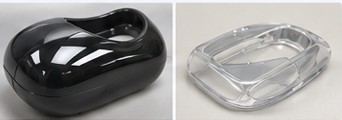
| Progressive mechanical abrasion (sandpaper, compound, buffing wheel) or chemical/vapor polishing removes micro-irregularities to achieve a mirror or high-gloss finish. |
| 2. Steps |
| Coarse → medium grind → fine buff (wax/compound) → mirror gloss |
| 3. Advantages |
| Improves optical clarity, ideal for lenses/high-gloss trim |
| 4. Limitations |
| Labor-intensive; mirror surfaces show fingerprints/scratches easily |
| 5. Key Parameters |
| (1) Roughness |
| (2) Grit |
| (3) Gloss |
| 6. Applications |
|
Automotive light guides, cosmetic mirror-finish housings, optical lenses
|
| Matte / Frosting Treatment |
| 1. Principle |
| Achieved via mold-surface texturing (replicated during molding), sandblasting the molded part, or applying matte lacquer — all create a micro-rough surface that scatters light. |
| 2. Methods |
| A) Mold texture etch |
| B) Part sandblasting |
| C) Matte lacquer coat |
| 3. Advantages |
| Soft tactile feel, fingerprint-resistant, hides minor scratches |
| 4. Limitations |
| Mold etching is costly; sandblasting may round sharp edges |
| 5. Key Parameters |
| (1) Texture grade |
| (2) Gloss |
| (3) Grit size |
| 6. Applications |
|
Laptop bodies, remote-control shells, anti-glare automotive interior panels
|
| Hairline Finish (Brushing) |
| 1. Principle |
| Traditionally created by unidirectional belt-grinding (mainly on metal); for plastics, the look is typically replicated via UV transfer film or IMD (in-mold decoration). |
| 2. Methods |
| A) Unidirectional abrasive belt brushing |
| B) UV transfer-film texture |
| 3. Advantages |
| Refined linear metallic look with fingerprint resistance |
| 4. Limitations |
| Line direction must align with product form or it looks off |
| 5. Key Parameters |
| (1) Texture spacing |
| (2) Abrasive belt mesh |
| (3) Replication method |
| 6. Applications |
|
Laptop bezels, appliance control panels, phone-frame metal-look decoration
|
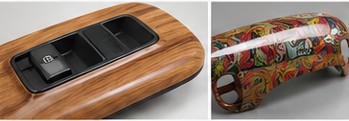
| Water Transfer Printing (Hydrographics) |
| 1. Principle |
|
A printed water-soluble PVA film floats on water and is activated; the part is dipped vertically, letting water pressure wrap the pattern fully around its 3D surface, then rinsed and clear-coated. |
| 2. Steps |
| Film floats & activates → Part dips vertically → Water pressure → Rinsing + protective coating |
| 3. Advantages |
| (1)Wraps complex 3D shapes seamlessly, unlike flat printing |
| (2)Wide pattern library: wood grain, carbon fiber, camo, marble |
| 4. Limitations |
| Pattern seams may overlap; yield highly operator-dependent |
| 5. Key Parameters |
| (1) Water temperature |
| (2) Film thickness |
| (3) Activation time |
| 6. Applications |
|
Automotive interior wood/carbon trim, helmet camo finishes, faux-texture electronics accessories
|
© 2026 ShengYih Technologies Co., Ltd All rights reserved.